



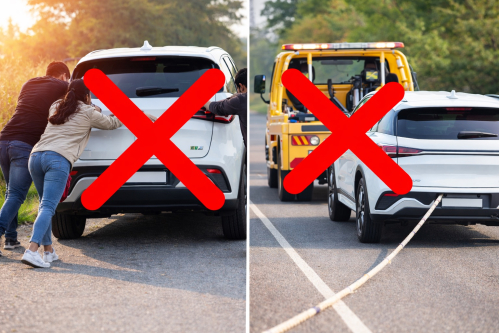
Electric vehicles are growing rapidly in Nepal. From Kathmandu city traffic to long highway travel, more drivers are choosing EVs because of lower running costs, reduced maintenance, and freedom from rising fuel prices. Popular models such as BYD Dolphin, BYD Atto 3, MG ZS EV, Tata Nexon EV, and many others are now common on Nepali roads.
However, while EV ownership is increasing fast, many drivers are still learning an important truth: an EV should not always be handled like a petrol or diesel car during a breakdown.
One of the most common mistakes happens when the vehicle stops or refuses to start. Many people think the fastest solution is to push it, tow it with a rope, or drag it to a nearby garage. That may sound practical, but in many EVs, doing this incorrectly can create electrical faults, hidden damage, expensive repairs, and even insurance claim problems.
Why This Warning Exists
Many EV owners see a warning like this:
Do not push or tow with wheels on the ground.
This warning exists because the drive wheels in many EVs are connected to the electric motor through a gearbox or reduction gear. During normal driving, power flows from the battery to the motor, and the motor turns the wheels. But if the wheels are forced to rotate from outside movement, they may spin the motor in reverse.
In simple terms, when the car moves, the motor may also move. When the motor spins unexpectedly, it can generate electricity, create heat, and place stress on electronic systems that may not be ready for it. That is why towing an EV incorrectly is not just a transport issue. It can also become a technical issue.
Unexpected Electricity Generation
An EV motor does not only create motion. It can also work like a generator. This is the same technology used in regenerative braking, where the car recovers energy while slowing down.
If the wheels force the motor to spin while towing, electricity may be generated even when the car is off or in fault mode. In that situation, the vehicle may not be prepared to manage the flow of energy in the normal way.
- Warning lights may appear on the dashboard
- The vehicle may refuse to start properly later
- Safety systems may activate to protect the car
- Sensitive electrical components may experience extra stress
In very simple words, it is like forcing electricity into a machine that was not switched on properly.
Heat Build-Up
Whenever electrical parts work or mechanical parts move, heat is produced. This is completely normal during regular driving because EVs use cooling systems to control temperature.
But if the car is off and the motor is still spinning because the wheels are rolling during towing, the cooling systems may not operate in the usual way. That means unwanted heat can build up inside the motor, inverter, or surrounding components.
- Extra heat inside important drivetrain parts
- Faster wear of internal components
- Performance warnings from the vehicle
- Protective shutdowns to prevent further issues
A simple way to understand this is to imagine running a machine without enough fan cooling.
Stress on Inverter and Electronics
The inverter is one of the most important parts of an EV. It controls how power moves between the battery and the motor. It is also one of the expensive systems to repair if something goes wrong.
If the motor spins unexpectedly during towing, unusual electrical behavior may occur. These electronics are designed to work under controlled conditions, so improper towing can place unnecessary stress on them.
- Electronic faults
- Costly repair bills
- The vehicle may not go into Drive mode properly
- The need for workshop diagnosis and system checks
In layman terms, it is similar to a sudden power fluctuation affecting a computer motherboard.
Fault Codes and Warning Lights
Modern EVs constantly monitor important systems such as battery health, wheel speed, voltage, temperature, and overall drivetrain behavior. If something unusual happens during towing, the car may record it as a fault even if you do not see visible damage immediately.
- Dashboard warning lights
- Reduced power mode
- The need for a reset or diagnostic scan
- A service center visit before the car returns to normal
Sometimes no major physical damage happens, but the vehicle still stores an error that needs to be checked and cleared.
Why This Matters in Nepal
This topic is especially important in Nepal because EV ownership is rising every year, but EV-specific roadside recovery knowledge is still developing. If a car stops on a hill road, on a highway, outside city areas, or even in traffic, people may quickly suggest using a rope and towing it like an old fuel car.
The advice is usually well-intentioned, but it may not be correct for an EV. As Nepal moves toward electric mobility, driver awareness is becoming just as important as charging infrastructure.
What You Should Do If Your EV Stops
If your EV stops or does not start, stay calm and focus on safety first. Turn on the hazard lights and move the vehicle to a safer side if possible. Check the warning messages on the screen carefully, because many times the dashboard gives useful clues about what has gone wrong.
- Make sure the car is properly in Park
- Confirm that the key is detected
- Check the battery charge level
- Read any warning message carefully
- Contact support if the problem remains
If recovery is needed, the safest option is usually a flatbed tow truck or the manufacturer-approved towing method for your exact model.
Insurance Risk: Can Claims Be Rejected?
Many owners assume insurance will always cover damage during a breakdown situation. That is not always guaranteed.
Insurance decisions often depend on policy wording, the cause of damage, surveyor findings, and whether the vehicle was handled properly. If damage happens after improper towing or dragging, the insurer may question the claim or reduce coverage depending on the case.
- Read the insurance policy carefully
- Save roadside assistance numbers in advance
- Follow the owner manual instructions
- Keep photos or evidence during breakdown recovery
In short, it is not wise to assume that every towing-related problem will be automatically covered by insurance.
What You Should Never Do
- Do not push an EV to jump start it
- Do not drag it with the drive wheels on the road
- Do not panic and keep pressing buttons repeatedly
- Do not force the gear selector
- Do not open battery parts or orange high-voltage components
- Do not assume insurance will always pay for improper handling damage
Electric vehicles are reliable, efficient, and well suited for Nepal’s growing transport future. But they require a different mindset from traditional fuel cars.
What seems like a quick roadside solution can sometimes turn into a larger and more expensive problem. Understanding why you should not push or tow an EV with wheels on the ground can help you avoid hidden damage, warning faults, repair costs, and claim disputes.
As more EVs enter Nepali roads, informed drivers will always be in the strongest position.
0 Comments